

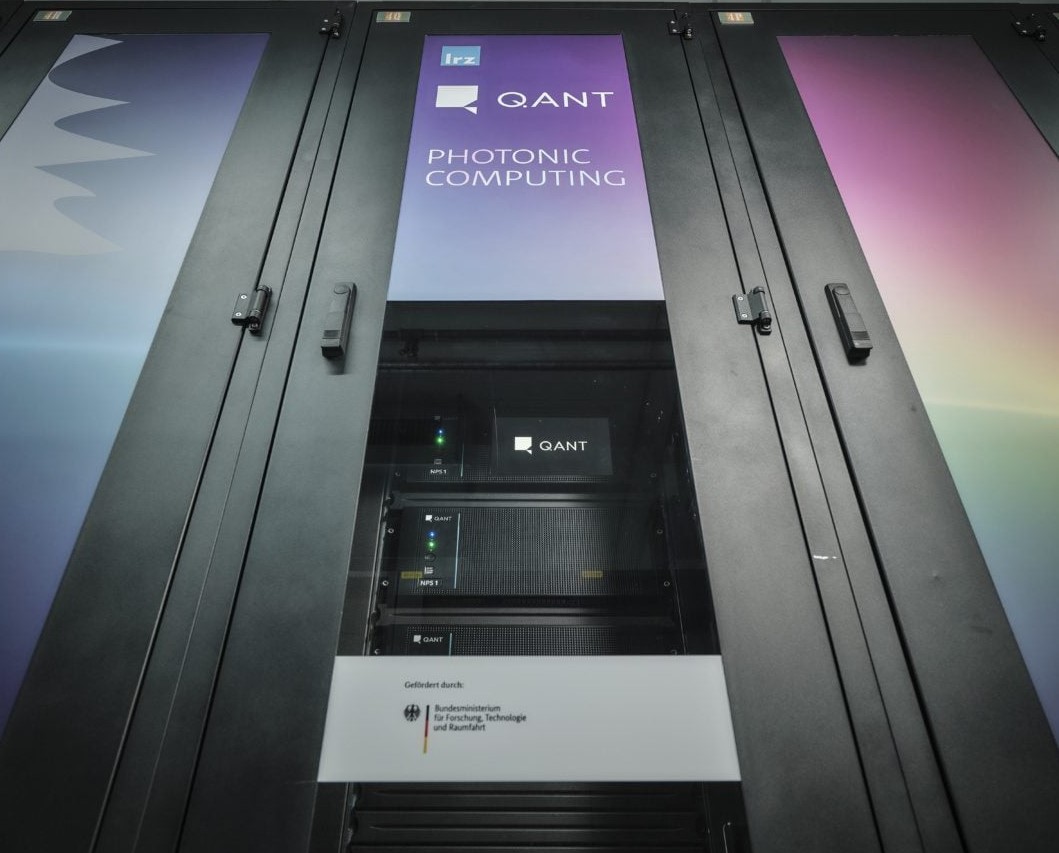
A new era in artificial intelligence has dawned with the successful activation of the world’s first AI photonic processor. German photonic processor developer Q.ANT has delivered its ground-breaking Native Processing Server (NPS) to the Leibniz Supercomputing Centre (LRZ), marking a pivotal moment in the integration of analog photonic co-processors into operational high-performance computing (HPC) environments. This landmark deployment is set to revolutionize AI and simulation workloads, promising vastly improved energy efficiency and unprecedented computational speed.
Current AI processors, largely reliant on electronic semiconductors, are increasingly hitting fundamental limits in terms of power consumption, heat generation, and processing speed as AI models grow in complexity. Photonic processors, which use light instead of electricity to carry and manipulate information, offer a compelling solution to these challenges.
Q.ANT’s NPS system leverages the unique properties of light to perform complex calculations faster and more efficiently. A significant advantage is the absence of on-chip heat generation, eliminating the need for costly and energy-intensive cooling measures. This not only reduces the environmental footprint of data centers but also allows for a substantial increase in computational density, potentially enabling 100 times greater capacity per rack and up to 90 times lower power consumption per workload compared to traditional electronic systems.
The LRZ, one of Europe’s largest and most advanced data centers, will utilize Q.ANT’s NPS in a research project aimed at establishing new benchmarks and real-world use cases. Initial evaluations will focus on AI inference, computer vision, and physics simulations, including applications in climate modeling, real-time medical imaging, and materials simulation for fusion research. This collaboration, funded by the German Federal Ministry of Research, Technology, and Space, seeks to research hybrid digital-analog architectures for future HPC environments.
Dr. Michael Förtsch, CEO of Q.ANT, emphasized the significance of this milestone: “Our collaboration with LRZ marks a pivotal milestone: for the first time in history, we’re operating photonic processors in an HPC under practical workloads. With this step, we demonstrate that light-based processors have moved beyond research and into real-world application.”
Prof. Dr. Dieter Kranzlmüller, Chairman of the Board of Directors of LRZ, echoed this sentiment, stating, “Photonic processors offer a novel and promising path to accelerate AI and simulation workloads, while sharply reducing our environmental footprint. This deployment marks a milestone in our future computing mission to advance energy-efficient AI and high-performance computing.”
This breakthrough signals a decisive step toward integrating photonic computing into the mainstream of next-generation computer architecture by 2030, promising to reshape the landscape of AI and high-performance computing.