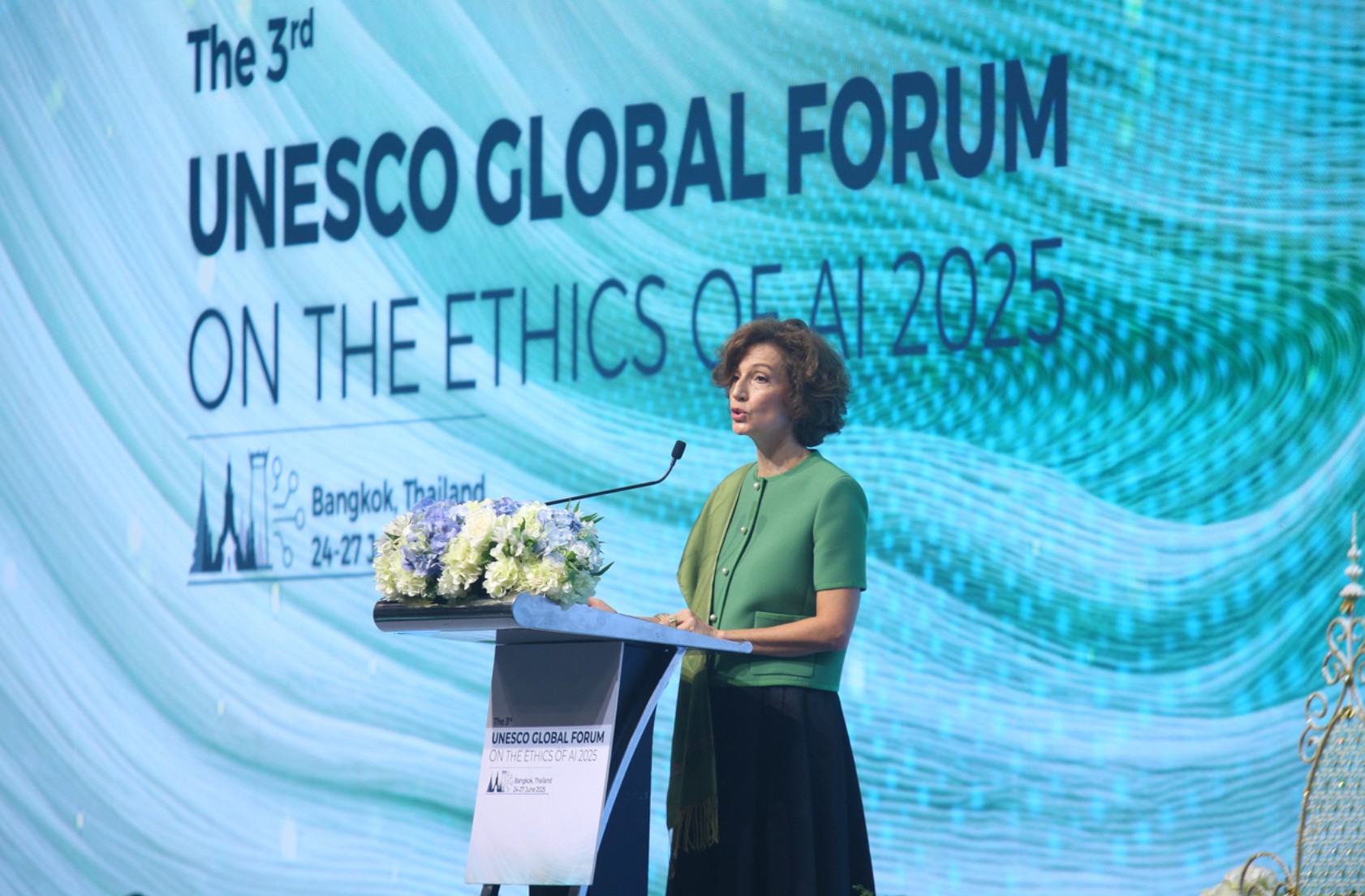
The United Nations Educational, Scientific and Cultural Organization (UNESCO) successfully concluded its 3rd Global Forum on the Ethics of AI in Bangkok, Thailand, last week, galvanizing international commitment towards the responsible development and deployment of artificial intelligence. The forum, co-hosted by Thailand, marked a significant milestone as the first of its kind in the Asia-Pacific region, bringing together over 1,200 participants from 88 countries, including more than 35 ministers and 13 intergovernmental bodies.
The event underscored a clear and resounding message: ethics are not an impediment to innovation but rather instrumental to its advancement. Director-General Audrey Azoulay emphasized that AI is profoundly reshaping human existence, calling for collective action to steer it in an ethical direction. “It requires international cooperation,” Azoulay urged, “And this is what UNESCO, our common organization, is working to do: to prepare the world for AI and to prepare AI for the world.”
Building on its innovative 2021 Recommendation on the Ethics of AI – the first and only global normative framework on AI ethics – the Bangkok Forum aimed to accelerate its implementation worldwide. Discussions across 22 thematic sessions and 11 side-events delved into critical areas such as gender equality, environmental impact, health, disaster risk reduction, disabilities, education, culture, neurotechnology, quantum computing, and judicial systems. Notably, representatives from Small Island Developing States (SIDS) played a crucial role, amplifying voices from Asia, Africa, and Latin America to advocate for equitable, human-centered AI that addresses unique national and regional challenges.
A key highlight of the forum was the launch of significant initiatives designed to bolster global AI governance. These include the newly established Global Network of AI Supervisory Authorities, developed in collaboration with national regulators to facilitate knowledge sharing and capacity building for effective AI policy implementation. Additionally, the Global Network of Civil Society and Academia was inaugurated to foster citizen participation in AI-related decision-making processes worldwide.
Ministers and experts engaged in high-level discussions informed by UNESCO’s Readiness Assessment Methodology (RAM), a tool helping over 70 countries align their national AI strategies with the global ethical standard. Thai Prime Minister Paetongtarn Shinawatra reaffirmed Thailand’s commitment to UNESCO’s ethical vision, announcing the development of a tool to track member states’ implementation of the AI ethics recommendations and the launch of the region’s first AI Governance Practice Center in collaboration with UNESCO.
The Bangkok Forum served as a powerful testament to the growing global consensus that while AI offers immense potential for progress, its development must be guided by ethical principles to ensure it serves humanity inclusively, accountably, and responsibly. UNESCO remains steadfast in its mission to shape a future where ethical considerations are at the forefront of AI innovation for the benefit of all.